%3Aformat(webp)%2Fhubspot_blogs%2F62527354999-VietnamSehenswrdigkeitenbanner.jpg&w=1920&q=75)
Everyone loves Vietnam: for its cuisine, its paradisiacal beaches and breathtaking bays, its warm-hearted people, its lush green rice terraces and its temples. It's hard, if not impossible, to put together a list of just 10 of the best sights in Vietnam!
Anyone wanting to visit Vietnam should not only read up on the things to do and experience there – but also be aware of the sheer length of the country!
And its turbulent history deserves attention too: for 22 years, Vietnam was divided exactly along the 17th parallel. Conflict shaped the country, but as different as North and South Vietnam long were politically, so varied are the landscape and climate too. Both are definitely worth a visit!
:format(webp)/hubspot_blogs/62527354999-vietnamkartede.svg)
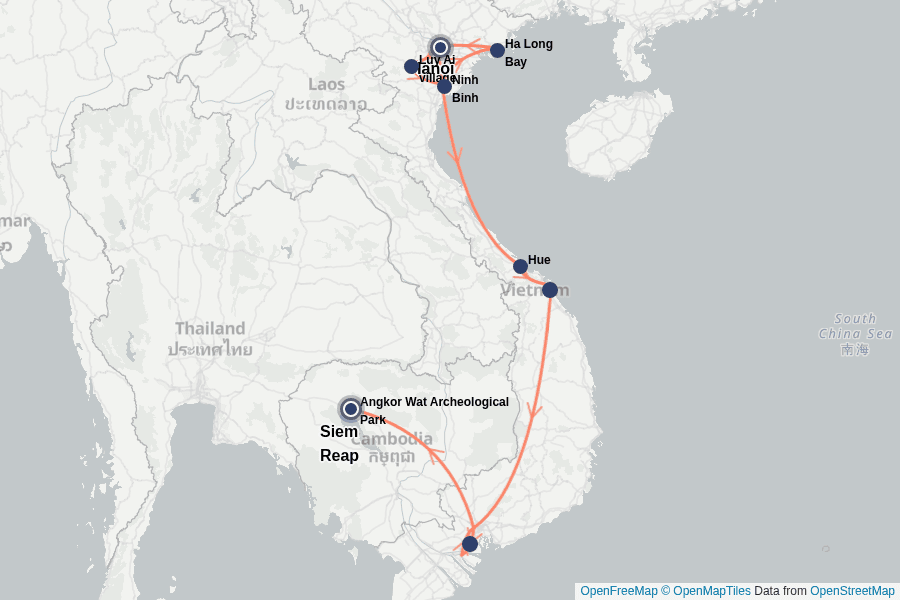
In the north, the sights of Hanoi and the famous Halong Bay with its attractions beckon – these places are so famous that they definitely belong among the classic Vietnam travel tips.
But the lush green mountain landscapes around the highest mountain in the north and the marshlands around the largest city in the south, Ho Chi Minh City, are inevitably among Vietnam's sights too!
What you should always keep in mind, though: because Vietnam is such a long country, there are big differences in scenery and climate zones.
Each is fascinating in its own way, and on the ground you get a feel for how the economy and everyday life work. The interesting parts of the country give you an insight into Vietnam's history and help you better understand what drives its people and what makes them tick.
While the northern regions around the 3,144-metre Phan Xi Păng mountain are home mainly to ethnic minorities, in the south, on the edge of the Mekong Delta, you'll meet the densely populated metropolis of Ho Chi Minh City.
In the subtropical north, you can experience traditional rural life in the picturesque villages around the golden rice terraces in relatively mild winter temperatures.
In the tropical southern economic centre of Ho Chi Minh City, on the other hand, you explore the skyscrapers and the mad motorbike traffic all year round – working up a sweat.
The centre is for the history-conscious. Worth seeing are the old imperial city of Huế and the military zone around the once fiercely fought-over dividing line at the 17th parallel.
%3Aformat(webp)%2Fhubspot_blogs%2F62527354999-SapaNorthVietnam.jpg&w=1920&q=75)
Sapa – northern Vietnam. Source: Canva
%3Aformat(webp)%2Fhubspot_blogs%2F62527354999-imagepngJun15202211185590AM.png&w=1920&q=75)
Hanoi was the capital of the communist north when Vietnam was still divided. Today it's the capital of a reunited Vietnam. Hanoi is also Vietnam's culinary capital and a fantastic place to try the country's best pho soup and bun cha.
In the city you should visit the Ho Chi Minh Mausoleum. The former prime minister of the Democratic Republic of Vietnam played a decisive role in freeing the country from French colonial rule. Later he played an important part in the attempts to reunite North and South Vietnam.
Ho Chi Minh is still a kind of national hero today, honoured across the country at every opportunity.
%3Aformat(webp)%2Fhubspot_blogs%2F62527354999-Hanoi.jpg&w=1920&q=75)
Source: Canva
You've surely come across pictures of the dreamlike Halong Bay on various postcards before. Its karst rocks, towering hundreds of metres high, and the azure water offer a truly breathtaking backdrop that alone is reason to visit Vietnam.
%3Aformat(webp)%2Fhubspot_blogs%2F62527354999-HalongBay.jpg&w=1920&q=75)
But the bay's rocky islands and caves aren't just pretty to look at; they also played an important role in the war. On the largest island, Cát Bà, the sick and refugees once found shelter – in a cave that was promptly converted into a hospital able to take 300 patients.
Today, Ha Long is part of the UNESCO World Natural Heritage.
%3Aformat(webp)%2Fhubspot_blogs%2F62527354999-PuLuong.jpg&w=1920&q=75)
Four hours' drive south-west of Hanoi lies the Pù Luông nature reserve, and we definitely count it among Vietnam's hidden gems.
Marvel at the great biodiversity in the park and the majestic rice valleys, which turn each year at certain times from lush green to glowing gold. The sight of them also gives you a sense of how important rice cultivation is to the country. Vietnam is one of the largest rice exporters in the world, selling around 6 million tonnes to other countries each year.
%3Aformat(webp)%2Fhubspot_blogs%2F62527354999-imagepngJun15202211205353AM.png&w=1920&q=75)
Huế was the capital of Vietnam from 1802 to 1945. The old citadel gives an impression of the magnificent imperial city that once stood here.
The city has kept a charming face, with lakes, canals and lush vegetation. Thanks to its many food stalls and cook shops, it counts as one of the Vietnam travel tips for foodies.
Not far from Huế ran the border between North and South Vietnam during the country's division.
%3Aformat(webp)%2Fhubspot_blogs%2F62527354999-Hue.jpg&w=1920&q=75)
Source: Canva
The demilitarised zone is a harrowing strip of land stretching about 5 kilometres on either side of the Ben Hai River. Not much of the old infrastructure remains.
Nonetheless, the DMZ is interesting for anyone who wants to get a first-hand picture of the horrors of the Vietnam War.
Destroyed foundations, old monuments, war cemeteries, an old US airfield and the odd rusty tank. All around is a lot of “nothing”. Set amid bizarrely jagged jungle, the area leaves plenty of room for memory and remembrance.
%3Aformat(webp)%2Fhubspot_blogs%2F62527354999-HoiAnMain.jpg&w=1920&q=75)
Source: Canva
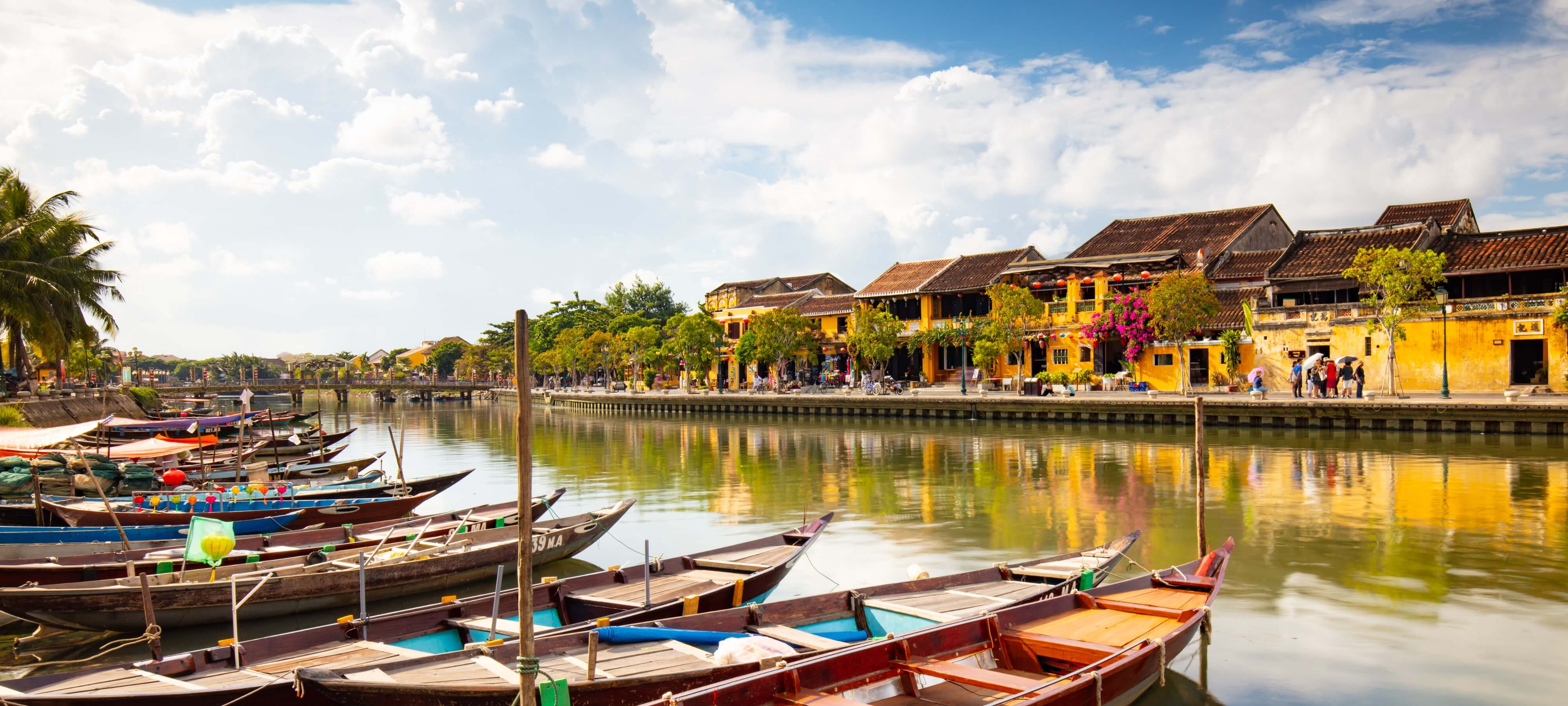
Anyone who wants to digest the visit to the DMZ heads for the delightful neighbouring town of Hoi An – ideally by train.
The “Reunification Express” has once again connected North and South Vietnam since 1975 and runs over the breathtaking Hai Van Pass. During the Vietnam War the line was almost completely destroyed. But after the withdrawal of US troops, it was rebuilt.
Definitely one of the things to do in Vietnam: a train journey on this route!
%3Aformat(webp)%2Fhubspot_blogs%2F62527354999-HoiAn.jpg&w=1920&q=75)
Source: Canva
Hội An itself miraculously remained unscathed in the war, and its picture-book old town with its many canals is today a UNESCO World Heritage Site. The town is considered a well-preserved example of a South-East Asian trading port from the 15th to the 19th century.
%3Aformat(webp)%2Fhubspot_blogs%2F62527354999-imagepngJun15202211224422AM.png&w=1920&q=75)
If Hanoi was once the capital of communist North Vietnam, Saigon, as it was then called, served until 1975 as the capital of Western-oriented South Vietnam. After reunification, the city was renamed Ho Chi Minh City in his honour.
With almost eight million inhabitants and four million motorbikes, Ho Chi Minh City is full of life. Dive into the chaos of the traffic to get an authentic feel for Vietnamese big-city life.
Anyone glancing at the map of Vietnam will see: the city lies north of the Mekong Delta, the fertile “rice bowl of the south”.
%3Aformat(webp)%2Fhubspot_blogs%2F62527354999-cfd4fe8274704df69637cd425eea9ab31200x18004x653.webp&w=1920&q=75)
70 kilometres from Ho Chi Minh City, near Cu Chi, lies an underground tunnel network that the Viet Cong fighters of South Vietnam's communist liberation front used.
This let them transport weapons, supplies and people undetected. In the end, the tunnel network stretched for 200 kilometres over three levels! It included entire storerooms, weapons factories, living areas and field hospitals.
Access was through trapdoors camouflaged with grass and leaves.
%3Aformat(webp)%2Fhubspot_blogs%2F62527354999-CuChiTunnel.jpg&w=1920&q=75)
It's highly fascinating that the Viet Cong were able to maintain their tunnel network despite poison-gas attacks, bombing and flooding by the Americans. It shows how tough and resilient the guerrilla movement was!
Visiting the remains of these tunnels is definitely one of the many exciting things to do in Vietnam.
The Mekong Delta is a 39,000-square-kilometre region of flat alluvial soil, criss-crossed by thousands of waterways and tributaries of the mighty Mekong River.
The area is so fertile that rice can be harvested three times a year – around 16 million tonnes!
Beyond that, farmers grow coconuts, sugar cane, tropical fruit and vegetables. The tropical climate in southern Vietnam helps too, staying around 27 degrees all year round with little variation.
%3Aformat(webp)%2Fhubspot_blogs%2F62527354999-MekongDelta.jpg&w=1920&q=75)
A boat in the Mekong Delta
Life on the Mekong plays out largely on the water. Most residents even live on the water, and every hut, however small, has access to a waterway.
A connection to a drivable road, on the other hand, is far from available everywhere.
The Mekong Delta is of crucial agricultural importance to the whole of Vietnam. No wonder it was fiercely fought over by the Viet Cong and US forces during the Vietnam War.
%3Aformat(webp)%2Fhubspot_blogs%2F62527354999-HCMC.jpg&w=1920&q=75)
Source: Canva
Have all these exciting, beautiful and delicious Vietnam sights won you over? If you'd like to visit Vietnam, you might fancy browsing our current Vietnam itineraries! There's our Vietnam tour, for example, which takes you not only to many historic places but also into contact with the locals and – of course – with the cuisine and culture.
%3Aformat(webp)%2Fhubspot_blogs%2F62527354999-andrew.png&w=1920&q=75)
Contact us
We’d love to hear from you. Please fill out this form.
All fields marked with (*) are mandatory.
%3Aformat(webp)%2Fb64d4be5-0395-483e-b81e-21703ae94421-326759.jpg&w=1920&q=75)
%3Aformat(webp)%2Fhubspot_blogs%2F50221600861-raileyKrabiThailandBeach.jpg&w=1920&q=75)
%3Aformat(webp)%2Fheader_media%2Fc3743351-0cbe-486f-8fd5-1ec3c554c33a-pexels-kelly-19063459.jpg&w=1920&q=75)
%3Aformat(webp)%2F36886ef5-5e69-4420-84fb-0adbc5078dd4-asia_ventura_logo_1200px_full_color.png&w=1920&q=75)
%3Aformat(webp)%2Fday_detail%2F513e6e8d-24fa-4dca-bb59-ecd3b68638da-8791slide33.jpg&w=1920&q=75)
%3Aformat(webp)%2Fimg%2F2048x1536%2F5c92be4b6ca64.jpg&w=1920&q=75)
%3Aformat(webp)%2Fhubspot_blogs%2F79080211244-bayonAngkorWatcambodia.jpg&w=1920&q=75)
%3Aformat(webp)%2Fhighlight%2F3174da1c-4b15-4522-8976-4192e421e767-japanese-bridge-hoi-an-hoian-vietnam-33-1-.jpg&w=1920&q=75)
%3Aformat(webp)%2Fheader_media%2F1cbb633f-14e5-41cc-93b2-d181d059c9e4-pexels-d-ng-nhan-324384-1102398.jpg&w=1920&q=75)
%3Aformat(webp)%2Fmedia-admin%2F38700cac-d9b9-48fc-9f31-1cecc2e47a1b-cambodia-people-friendly-cut.jpg&w=1920&q=75)
%3Aformat(webp)%2Fheader_media%2F7fe37920-678f-438f-8a90-458b92a0982a-architecture-asian-architecture-temple-door-wallpaper-6bd69c6db3317f6955b46bc9fdac8ce0.jpg&w=1920&q=75)
%3Aformat(webp)%2Fheader_media%2Fa48fa6e2-4e1d-41b2-b802-61158f99fbc1-img_5076.jpg&w=1920&q=75)
%3Aformat(webp)%2Ftravel_report_photo%2F82613%2F9bd8b7f8-efbf-47a0-8bac-85692944c35d-156B2013-99D6-42A0-9D70-16482BDABD13.jpg&w=1920&q=75)