%3Aformat(webp)%2Fhubspot_blogs%2F87843198736-reunificationexpresstrainvietnamheaderBPasia.png&w=1920&q=75)
%3Aformat(webp)%2Fhubspot_blogs%2F87843198736-SocialMediamanonasiaventurablog.jpg&w=1920&q=75)
Do you love travelling by train? The sound of engines rumbling away steadily, the jolts and judders as the train sets off along the rails? It's true that, depending on the class you choose, a train journey in Vietnam has little in common with a ride on a high-speed express. But all of that is quickly forgotten the moment the train pulls away and the first breathtaking scenes of the Vietnamese landscape begin to roll past your window.
The Reunification Express in Vietnam is a very special line that will delight railway enthusiasts and keen travellers alike. The Reunification Express is the name given to the north–south line of Vietnam's railways. It links the city of Hanoi in the north with Ho Chi Minh City in the south. All aboard!
Although it isn't its official name, the term Reunification Express refers to the reunification of Vietnam. The line dates back to the French colonial era and was built between 1899 and 1936.
After being partly destroyed during the Second World War and then left to fall into disrepair for many years, the largely single-track railway line has undergone extensive repairs and renovations over recent decades. Today, you can travel the entire route in around 30 hours.
%3Aformat(webp)%2Fhubspot_blogs%2F87843198736-trainstreetvietnam2.jpg&w=1920&q=75)
Train Street in Hanoi - Source: Canva
A flight would be far quicker, wouldn't it? True enough. But that argument won't convince any traveller worthy of the name. Because the reasons for taking the train in Vietnam are simply unbeatable:
Unique views: rolling paddy fields, jungle, lively city districts and fishing villages await you all along your route.
Hop on, hop off: who said you have to stay in your seat for all 30 hours at a stretch? The Reunification Express route takes you to plenty of exciting places and towns, where you can spend a few hours or even a few days.
Meeting people: a train journey in Vietnam lets you meet people from all over the country. The unhurried pace of train travel gives you the time to chat and get to know one another.
The train is a real pleasure: you can simply relax and gaze out of the window as the train speeds along.
Time is running out! A new north–south express line is already in the pipeline and is due to be completed in 2050. It's not clear what will become of the ageing Reunification Express line. So make the most of the chance to take what may be one of the last journeys along this historic route.
To help you feel well prepared for your train journey across the land of dragons (don't worry, the preparations don't actually involve any real dragons), here is some useful information on timetables, travel classes, meals and more.
Four trains run along the line each day, two in the morning and two at night. As with many things in Vietnam, the timetable is really there to give you a rough idea. So don't expect Swiss-style punctuality.
On board the train itself there are several different classes, which vary considerably in terms of comfort. There are compartments with wooden benches or padded seats, as well as hard or soft sleeper berths. The berths fitted with mattresses ('soft sleeper') are found in air-conditioned four-berth compartments. The newest trains have power sockets and sometimes even Wi-Fi. In addition, the trains have compartments with unpadded berths. And, if you prefer: VIP cabins for two, so you can travel in comfort…
If you'd like to travel the entire Reunification Express route in one go, it's a good idea to stock up on a few snacks in advance. But you needn't worry about where your next meal is coming from. At many stations you can buy snacks and drinks directly from the train from roaming vendors. For your main meals, you can have breakfast, lunch and dinner in the restaurant car.
%3Aformat(webp)%2Fhubspot_blogs%2F87843198736-reunificationexpressvietnam.jpg&w=1920&q=75)
Source: Canva
Thirty hours is a long journey. There are around 35 stations along the Reunification Express route. So it's hardly surprising that you may well fancy stretching your legs for a few hours. Here are a few recommendations on places where it's worth hopping off.
'Train Street' in Hanoi
Only a few metres separate the rows of houses along this unusual street in Hanoi. At first glance it looks like a perfectly ordinary residential lane, one of countless such lanes in the Vietnamese capital. Children play, women cook and do the washing, and the men go about their business.
To many people it's known simply as 'Train Street'. And there's a good reason for that: a railway line, that of the Reunification Express, runs through this narrow lane. Twice a day the train squeezes its way between the houses. It announces its arrival with the vibration of the rails before letting out a whistle. And in a matter of seconds the tables and chairs are folded away and the children are ushered back inside. Just an everyday routine for the residents, but a real spectacle for tourists.
%3Aformat(webp)%2Fhubspot_blogs%2F87843198736-trainstreetvietnam.jpg&w=1920&q=75)
Source: Canva
Combine your train journey in Vietnam with a peaceful boat trip. In the Van Long Nature Reserve you can glide among the birds and karst rocks through dreamlike scenery. The wetlands are home to many remarkable bird species, such as the little spoonbill and the grey crake. With a bit of luck, you may also spot langurs, which are perfectly at home here. To reach the Van Long Nature Reserve, get off at Ninh Binh station, south of Hanoi. A bus or taxi will take you to the protected area. The boat trip lasts around 90 minutes.
%3Aformat(webp)%2Fhubspot_blogs%2F87843198736-vanlongvietnam.jpg&w=1920&q=75)
Van Long Nature Reserve - Source: Canva
Along the route of this one-of-a-kind railway line you'll also find the former imperial city of Hue. It lies roughly halfway between Hanoi and Ho Chi Minh City, so by the time you arrive here you'll have covered about half of the journey. With a population of almost 500,000, the city is the perfect place for a longer stopover.
Among its highlights is the citadel, which served as the residence of the emperor of the Nguyen dynasty. The site's distinctive architecture, with its wealth of detail and decorative murals, is well worth seeing. It's a special place in which to spend a few happy hours. Afterwards, take a stroll across the Thanh Toan Bridge, an ornately decorated bridge raised on wooden stilts above the river. Finally, treat yourself to the delicious street food at Dong Ba Market. And if you still have a little time, we'd also recommend a detour to the magnificent Thuan An beach.
%3Aformat(webp)%2Fhubspot_blogs%2F87843198736-imperialcityhuevietnam.jpg&w=1920&q=75)
The Imperial City of Hue - Source: Canva
The journey from Hue to Da Nang takes about four hours and passes through some of the most beautiful stretches of the Reunification Express route. The 21-kilometre-long Hai Van Pass lies along this section and is regarded as the natural boundary between the northern and southern provinces of the country. The tracks carry you across the foothills of the Truong Son mountains, reaching an altitude of up to 496 metres. The train has to cross 18 bridges and six tunnels. If you're travelling from north to south, try to get seats on the left-hand side of the train for an unobstructed view of the South China Sea and some lovely beaches. Those with the inclination and the time can stop off at one of the various stations along the pass, including Kim Lien, Hai Van Nam, Lang Co and Hai Van Bac, and explore the area while waiting for the next train.
%3Aformat(webp)%2Fhubspot_blogs%2F87843198736-haivanpassvietnam.jpg&w=1920&q=75)
Source: Canva
You'll reach the provincial city of Nha Trang during the final third of your journey south. There, 6 km of sandy beaches await you – the perfect chance to take a dip. Diving is very popular here, and the coral reefs are well worth a spot of snorkelling! A boat trip to one of the small offshore islands, such as Hon Mun or Yen Sao, is also worthwhile. Afterwards, you can tuck into a delicious crab dish with glass noodles (mien xao cua) or sun-dried squid (muc mot nang) at a local restaurant.
%3Aformat(webp)%2Fhubspot_blogs%2F87843198736-nhatrangvietnam.jpg&w=1920&q=75)
Nha Trang beach - Source: Canva
Discover the highlights of Vietnam Travel with us!
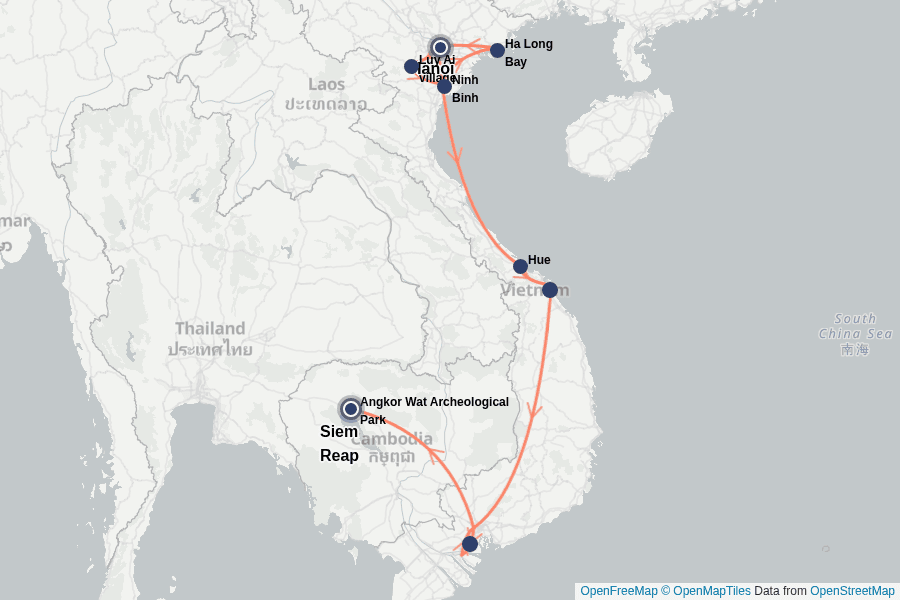
If you're interested in the history of Vietnam and would like to explore these historic places more closely, our 15-day round-trip tour of Vietnam is sure to delight you. As well as exploring historic cities such as Hanoi, Hue, Hoi An and Ho Chi Minh City, you'll get closer than ever to the local people, discover the country's incredible cultural richness, and savour the delights of Vietnamese cuisine each and every day.
%3Aformat(webp)%2Fhubspot_blogs%2F87843198736-imagepngMay23202211180999PM.jpg&w=1920&q=75)
Pu Luong rice valley and its mountain-dwelling ethnic minorities. Day and night cruise in Ha Long Bay. The Imperial Citadel of Hue, the old port town of Hoi An and the Old Quarter of Hanoi (UNESCO Sites). The coconut plantations of the Mekong Delta and discovering Ho Chi Minh City like a local!
Click here to sign up for our newsletter and receive the latest news and information. You can even enjoy exclusive early-bird discounts!
Contact us
We’d love to hear from you. Please fill out this form.
All fields marked with (*) are mandatory.
%3Aformat(webp)%2Fheader_media%2Fe7def509-8677-4ac0-81c8-fa653e19ce37-myanmar-bagan-banner.png&w=1920&q=75)
%3Aformat(webp)%2Fdestination%2F6d03011d-2f9a-4acf-bafd-15a2c9244bd6-adobestock_122754448-1-.jpg&w=1920&q=75)
%3Aformat(webp)%2Fheader_media%2F780c72b1-255a-46fe-9ac0-b2320fc21a4a-timelinecycle-1-.jpg&w=1920&q=75)
%3Aformat(webp)%2F36886ef5-5e69-4420-84fb-0adbc5078dd4-asia_ventura_logo_1200px_full_color.png&w=1920&q=75)
%3Aformat(webp)%2Fday_detail%2F513e6e8d-24fa-4dca-bb59-ecd3b68638da-8791slide33.jpg&w=1920&q=75)
%3Aformat(webp)%2Fimg%2F2048x1536%2F5c92be4b6ca64.jpg&w=1920&q=75)
%3Aformat(webp)%2Fhubspot_blogs%2F79080211244-bayonAngkorWatcambodia.jpg&w=1920&q=75)
%3Aformat(webp)%2Fhighlight%2F3174da1c-4b15-4522-8976-4192e421e767-japanese-bridge-hoi-an-hoian-vietnam-33-1-.jpg&w=1920&q=75)
%3Aformat(webp)%2Fheader_media%2F1cbb633f-14e5-41cc-93b2-d181d059c9e4-pexels-d-ng-nhan-324384-1102398.jpg&w=1920&q=75)
%3Aformat(webp)%2Fmedia-admin%2F38700cac-d9b9-48fc-9f31-1cecc2e47a1b-cambodia-people-friendly-cut.jpg&w=1920&q=75)
%3Aformat(webp)%2Fheader_media%2F7fe37920-678f-438f-8a90-458b92a0982a-architecture-asian-architecture-temple-door-wallpaper-6bd69c6db3317f6955b46bc9fdac8ce0.jpg&w=1920&q=75)
%3Aformat(webp)%2Fheader_media%2Fa48fa6e2-4e1d-41b2-b802-61158f99fbc1-img_5076.jpg&w=1920&q=75)
%3Aformat(webp)%2Ftravel_report_photo%2F82613%2F9bd8b7f8-efbf-47a0-8bac-85692944c35d-156B2013-99D6-42A0-9D70-16482BDABD13.jpg&w=1920&q=75)