%3Aformat(webp)%2Fhubspot_blogs%2F50221600861-raileyKrabiThailandBeach.jpg&w=1920&q=75)
Thailand is the gentler introduction. Vietnam is the more interesting journey. Both are excellent, and the choice is genuinely about temperament.
Thailand has decades of tourism behind it: the infrastructure is easy, the beaches are superb and the food is familiar enough to be reassuring and good enough to be a reason in itself. Vietnam asks a little more of you — it is denser, faster and more layered — and gives back more history and, many travellers would say, better food.
In short
Choose Thailand if this is your first trip to Asia, if you would like beach days as part of the holiday rather than an add-on, if you are travelling with someone who is nervous about the region, or if easy logistics matter to you.
Choose Vietnam and Cambodia if you want a journey with a shape to it — Hanoi in the north to Angkor in Cambodia, moving steadily south — if history and food are your reasons for going, and if you would rather see a country than rest in one.
Choose Thailand also if heat and humidity worry you; the itinerary has more opportunity to slow down.
Choose Vietnam if you have travelled in the region before and Thailand feels like the obvious option you have already half-done.
%3Aformat(webp)%2Fhubspot_blogs%2F48192275530-JimThompsonHouse2.jpg&w=1920&q=75)
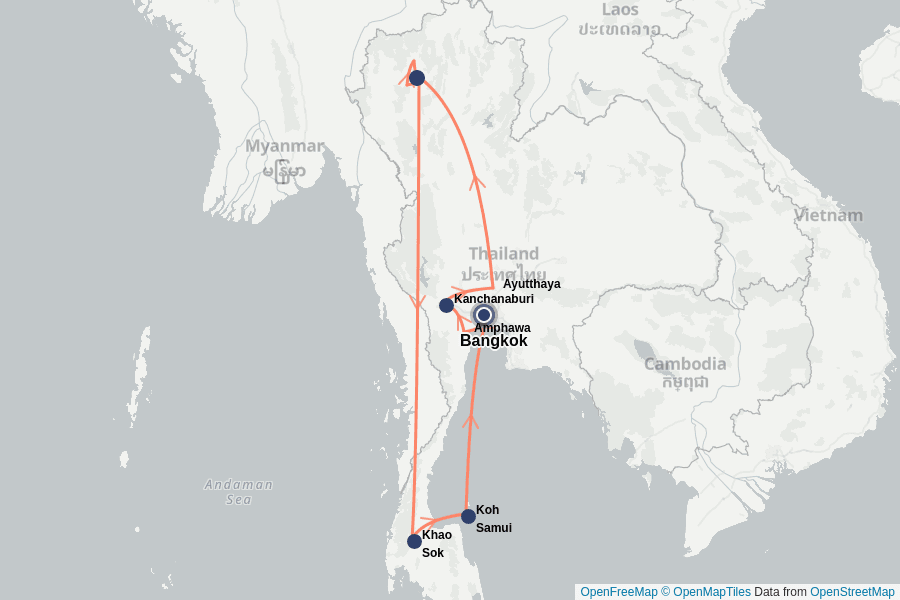
Thailand: Temples, jungles and dream beaches. The classic circuit — the temples and markets of the cities, the jungle and hill country of the north, and the beaches at the end. It is a trip with a rhythm of culture first, rest second, and it suits travellers who want the holiday to include a proper pause.
Vietnam & Cambodia: Temples, Bays and the Mekong — 14 days. Hanoi and the northern rice valleys, an overnight junk cruise in Ha Long Bay, the imperial city of Hue, the lantern streets and food of Hoi An, the Mekong Delta by boat, Ho Chi Minh City, then across into Cambodia for Angkor. Two regional flights are included; it is a moving trip with almost no backtracking.
One is a country explored. The other is a journey down a coastline and across a border.
%3Aformat(webp)%2Fnavi_link%2F87ff2f3b-cf71-4af6-aece-a7affe81434b-3000x2000-64.jpg&w=1920&q=75)
Heat and humidity. Both are hot. Vietnam is the more complicated case because north and south have genuinely different climates — which also means that on a two-week north-to-south route, at least one end is usually at its best. Thailand is more uniformly hot, with a clearer dry season.
Crowds. Thailand's famous places are busier, simply because more people have been going for longer. Vietnam's are busy too but the pressure is more concentrated in a few spots.
Ease. Thailand is the easier country to travel in — better roads, more English, more predictable service. Vietnam is not difficult, but it is denser and noisier, and traffic in Hanoi and Ho Chi Minh City is a genuine spectacle.
Food. Both are among the best food countries on earth. Vietnamese food is lighter and herb-driven; Thai food hotter and sweeter. This is not a tiebreaker so much as a pleasure either way.
Physical demands. Both are moderate: temple steps, market walking, boats, and heat that makes an afternoon rest sensible rather than lazy.
Two thoughts.
First, most travellers who go to one end up going to the other. Southeast Asia is a region people return to, and the order matters less than you think.
Second, if the beach is what you want and the culture is the bonus, take Thailand. If the journey is what you want and the beach would be nice, take Vietnam and Cambodia. That is genuinely how it divides.
Both tours carry a maximum of 12 travellers with an English-speaking Asiaventura tour leader throughout, and both are land-only — you book the international flights that suit you and we publish recommended routes and timings for each. Both run on guaranteed departures, so they go ahead regardless of how many others have booked.
Our Vietnam and Cambodia in two weeks page sets that route out day by day, and a specialist will tell you honestly which of the two suits what you have described.
%3Aformat(webp)%2Fheader_media%2Fe5081183-c269-4c56-8361-915d99fc6089-fotor_creation_2025-08-21-5-.jpg&w=1920&q=75)
%3Aformat(webp)%2Ftravel_report_photo%2F82615%2F3fa48142-9699-4086-981e-dd7c59059679-9D15969E-D0FD-4CCB-82A7-DCDDE059FD69.jpg&w=1920&q=75)