%3Aformat(webp)%2Fhubspot_blogs%2F82099769466-KhaosokNLHeader5.jpg&w=1920&q=75)
Fourteen days is enough for Thailand if you go north to south once and do not try to add the islands twice.
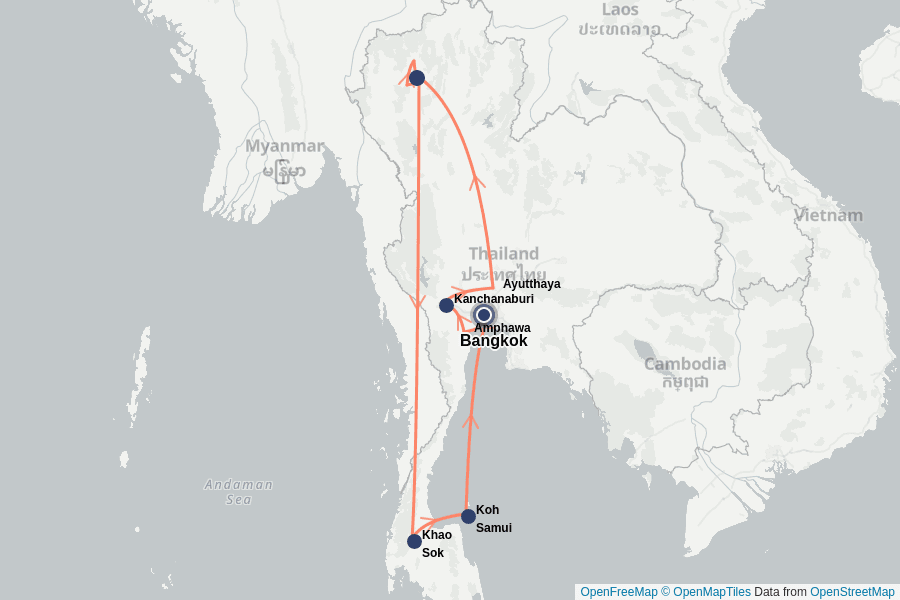
Thailand's problem for a first-time visitor is that it has too much: a great capital, a distinct northern culture, a rainforest older than the Amazon, and two entirely different coastlines. Our route takes one clean line through the lot and finishes at the beach.
In short
Days 1–3 — Bangkok. The Grand Palace, the Thonburi canals by boat and Chinatown; then a tuk-tuk day taking in traditional silk weaving and the city centre. Bangkok rewards more than the day most itineraries give it.
Day 4 — Amphawa. The Maeklong railway market, where the stalls fold away as the train passes through them, and the floating market on the Amphawa canal.
Day 5 — Kanchanaburi. The bridge on the River Kwai and the history around it.
Day 6 — Ayutthaya. The former capital and UNESCO site, then the evening flight north to Chiang Mai.
Days 7–9 — Chiang Mai. A free morning, the historic Lanna city and a meeting with a monk; then the elephant clinic; then Mae Wang, the rescued elephant sanctuary and the Karen community.
Days 10–12 — Khao Sok. One of the oldest rainforests on earth, and a raft trip on the river.
Days 12–14 — Koh Samui, including a full day off.
%3Aformat(webp)%2Fdestination%2Ff75f214a-2a5b-41cc-bf5d-5e9db05b85cf-wat-phra-that-doi-suthep-chiang-mai-temple-thailand.jpg&w=1920&q=75)
Because the alternative is worse, and because of what a holiday should feel like at the end.
Thailand's cultural weight is in the centre and the north — Bangkok, Ayutthaya, Chiang Mai and the Lanna kingdom. Its landscape and its rest are in the south. Running the route in that order means the demanding half comes first, while you are fresh, and the last three days are on a beach.
It also means the two internal flights do real work. Bangkok to Chiang Mai and Chiang Mai to Surat Thani are the two journeys that would otherwise eat entire days on the road. Everything else is overland.
Khao Sok in the middle is the part first-time visitors do not expect and most often name as the highlight: limestone cliffs, a rainforest older than the Amazon, and a raft trip where you paddle between the karsts watching for kingfishers and lizards, with a swim if you want one.
%3Aformat(webp)%2Fdestination%2F4da499dc-64a3-4964-a9ad-b8bdcec8fa4a-scenary-3-.jpg&w=1920&q=75)
Worth saying plainly, because Thailand is bigger than a fortnight.
The Andaman coast — Krabi, Phang Nga, Phuket. A different sea from Koh Samui's, and on the other side of the peninsula. Choosing one coast is unavoidable in fourteen days.
The far north — Chiang Rai, the Golden Triangle and the Mekong border country.
Isaan, the north-east, which almost no tour visits and which is where a great deal of the food comes from.
Sukhothai, the older capital before Ayutthaya.
If your instinct is to add a second country rather than more of Thailand, our comparison of Vietnam or Thailand and the guide to two-country trips that work are the right pages.
%3Aformat(webp)%2Fdestination%2F6d03011d-2f9a-4acf-bafd-15a2c9244bd6-adobestock_122754448-1-.jpg&w=1920&q=75)
Physically, moderate. City walking on hard surfaces, temple steps, and a rainforest with uneven paths. No trekking, no camping, and you do not carry your own luggage.
Heat is the real variable, as it is anywhere in the tropics. Thailand is hot and humid year-round; the cool dry months are the comfortable ones, and the itinerary starts early to use the best part of the day. If heat is a genuine problem rather than an inconvenience, read long-haul destinations if you struggle in the heat before booking.
Group size: a maximum of 12. On the Amphawa canals, in a monk's company and in a Karen village, that number is the difference between a conversation and an audience.
The trip is land-only, so you book the flights that suit you, and every departure is guaranteed — it goes ahead regardless of how many others have booked.
%3Aformat(webp)%2Fheader_media%2Fe5081183-c269-4c56-8361-915d99fc6089-fotor_creation_2025-08-21-5-.jpg&w=1920&q=75)
%3Aformat(webp)%2Ftravel_report_photo%2F82615%2F3fa48142-9699-4086-981e-dd7c59059679-9D15969E-D0FD-4CCB-82A7-DCDDE059FD69.jpg&w=1920&q=75)